
Chapter One: What is Co-Production?
Co-production is a way of working, where the people who provide a service collaborate with the people who use the service to achieve collective outcomes.
It means sharing ideas, decision-making, and responsibilities to improve services and outcomes for everyone involved.
Co-production is often a very broad and abstract term that doesn’t feel tangible and often feels like a difficult stage to reach.
“You’re probably already doing it in one way or another, we didn’t even realise!”
With organisations using the word co-production to mean different things it’s important to break down what it means when it comes to day centres and what it can look like in practice, as well as on paper.
It is important to acknowledge that not every day centre would be in a position to incorporate all types of co-production, all the time.
To embed co-production, day centres felt that it is more than just doing co-production, it is about a culture, and for it to work really well, that culture should be embedded at every level of the organisation.
“The top brass have invested in it quite heavily, and are really, really behind it.”
Co-production can often be used by organisations as a reflective and accountability tool. Organisations embarking on co-production journeys often feel nervous around this but members of staff within the daycentres felt that this was a huge positive as it leads to better transparency and improvements to the service and enables accountability and learning opportunities. It was common that when day centres started involving people with lived experience that it wasn’t negative, as staff were expecting. Part of this was thought to be down to the values organisations hold.
Co-production is a journey for people with lived experience and for organisations embarking on embedding co-production to their services.

Most people will describe co-production as a journey. Often this journey starts with listening, then involvement, then moves further towards embedded co-production.
As with all journeys, it’s good to see where you are, where you could be headed and to revisit and reflect on the places you’ve been.
A common visual for co-production is the co-production ladder. However this was felt too restrictive for many involved and also encouraged a negative attitude towards the ‘lower rungs’ on the ladder (see image below).

Many organisations felt that it created a culture of if it’s just involvement, or if it is just educating or consulting, then it wasn’t worth doing.
As well as an ultimate destination, individual activities can of course still be included under co-production.
Whereas in practice, starting off with the more manageable and easier co-production activities can set a good ground base for genuine co-production, which takes time and work in to relationship building.
Something to be aware of is that not every client will want to participate in co-production activities. Many people with lived experience will also surprise us with wanting to be more involved than we initially thought. Limiting our assumptions of what people with lived experience may want or not want to do, is particularly important as it allows for growth and learning. Managing and being realistic with our own expectations for any co-production activity we are doing means we can be realistic with barriers and outcomes.
“I think that the co production journey is going to be different in each of those organisations.”
The 999 Club created this spectrum of what co-production is and use this instead of the typical ladder.
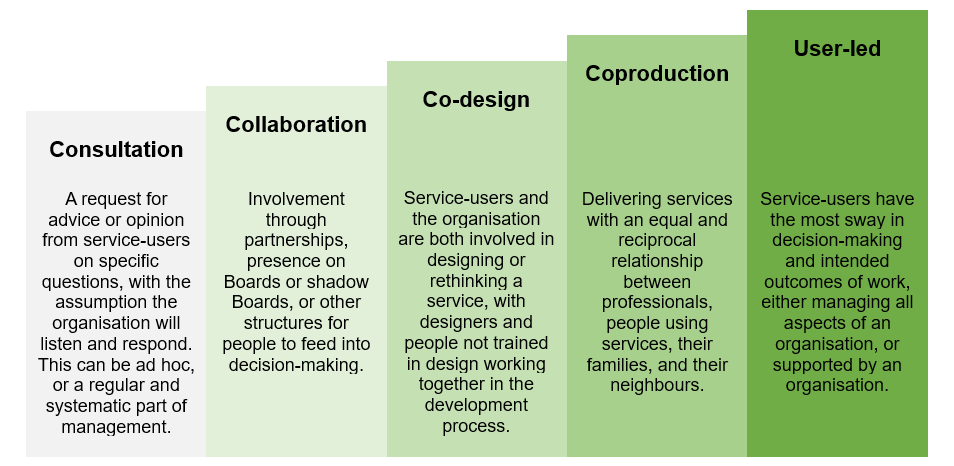
When discussing the journey of co-production it is vital that we discuss power at the same time.
In an organisation that has no form of co-production at all, the power structure is simple; Trustees at the top, CEO, Senior Leadership, Staff, Volunteers, Clients. In an organisation where any form of authentic co-production is taking place, power is shared.
Day centre staff acknowledged that fear was a main barrier when discussing or starting co-production within their centres. This is in part due to the power dynamics being shifted slightly. If you are genuinely collecting clients opinions on your service, you’re giving them the power to praise the service, but also to criticise the service. With something like a survey, that power is then back to the collector to action.
