
We wanted to join the Co-production program from Expert Link because we wanted to improve the involvement of our guests in our services.
Our charity was established as a winter night shelter and was a community response to raising numbers of rough sleepers in London Borough of Newham. Based on our guests’ feedback, a year later, we opened a day centre of purpose and belonging. Activities and professionals involved in running the day services were selected upon the needs of the beneficiaries. We listened to them carefully and observed what they struggled with, what they found useful, where they saw gaps in provision, and we tried to respond to those requests through different partnerships and specific funding.
In 2018, the day centre was commissioned and we have stayed in partnership with Newham since then. It meant a more structured response to rough sleeping, following guidance and meeting key performance indicators. Although we kept the person-centred approach and journeyed with each individual guest, we were unsure how our co-production was happening at our services.

At one of the first meetings, the representatives from five different day centres in London led by David from Expert Link discussed what the co-production is. We were surprised (and relieved) that what we thought was just a natural way of leading a charity was, in reality, a co-production process. David explained to us that the way we allow our guests to lead their cases and decide on key points in their support plan is actually giving them their voices back. We also recognised that co-production happened when our guests participated in different sessions and shaped the activity by deciding what they would like to do each week, who would cook the weekly lunch and what would be served. When we could offer an outing, our guests get to choose the destination.
Working alongside other day centres made us realise that co-production comes in different shapes and forms, and can depend on charity’s size and internal structure. Co-production can mean forming consultancy panels, working groups, providing peer support sessions, creating employment opportunities, and writing user-friendly policies and procedures. What we learnt is that some ideas can work in one charity but may not work somewhere else.
Participating in the Expert Link programme prompted us to make some improvements; they included a recruitment of a trustee with lived experience, and taking on trauma-informed training. We also strengthened our volunteering pathways, encouraging our guests to ‘own’ the services we offer to them. All of that led us to have a deeper understanding of people’s stories and to form stronger relationships with our guests.
The whole program was positive and reassured us that co-production is embedded within our culture. It comes with our charity’s values and is at the heart of what we do on a daily basis. We may not have used the same language to call it, and we may not even have been fully conscious of it, but we are grateful for this opportunity to be able to distinguish those elements in our work and learn about other options of developing it further.
The Members Committee is a group of members (service-users) and ex-members who have received support from the 999 Club and wish to contribute to the strategic development of the charity, drawing from their own experiences.
Essentially it’s the service-users version of the Board of Trustees. They work alongside the Board of Trustees and provide direct input on the strategic decisions that shape the future of the organisation.
The committee have quarterly meetings that are synchronised with the Board of Trustee meetings to ensure all sources have been consulted when major organisational decisions are made. There is 2-way communication with the Board. One trustee sponsors the Committee and attends the quarterly meetings. They act as an envoy that communicates between the Members Committee and the Board of Trustees.
The Committee feedback on areas such as strategy, policies or matters arising. Advice is sought on potential projects or service adaptations being considered. They help us review and feed into our approaches. They sign-off on major organisational decisions, as well as feedback on our work or matters arising. Moving forward they will also be responsible for evaluating and auditing our Coproduction work annually.
We made a conscious decision to keep the two groups (Board of Trustees and Members Committee) separate. Taking service-users and placing them in a board-room setting immediately shifts the balance of power towards those who are comfortable in those settings (board members) and can stifle engagement, discussion and confidence in those who aren’t used to the setting and the formalities.
“This gives them confidence to voice their opinions and to lead the discussion where they feel is important. It is their space.”
It’s not always enough to offer equal power, as in reality service-users rarely come close to holding an equal share. So in some situations it’s important to give them more power.
We do this by holding the Members Committee in a space that they are comfortable in, they have control over that space and are familiar with it. They also outnumber the Board of Trustees (5-1 or 6-1) who in the quarterly meetings are represented by just one person. She steps into the service-user’s world, giving them the larger share of power.
This gives them confidence to voice their opinions and to lead the discussion where they feel is important. It is their space.
The 999 Club recently made major changes to its access rules for our day-centre. We were considering moving from being open-to-all, to only allowing access to those who were ‘un-housed’. Staff members were anxious over these changes, fearing there would be huge resistance from our members (service-users). There was an unease, disagreement and nervousness as we strategised if we should, and how best to go about, make the changes.
It was on the agenda for the Members Committee, who ended up being even more firm and restrictive on what they felt the new access rules should be. When the minutes were passed to the staff there was a collective sense of relief.
Staff members had more confidence in implementing these changes as they had been endorsed by the people using the service. It was like getting a stamp of approval and it resulted in more agreement by all, that the decisions we were making were the right ones for us. (There was a similar outcome when we refreshed our Member’s Code of Conduct Agreement).
It can be difficult keeping voices fresh in the Committee. The instinct is to hold on to individuals who are actively engaging because they have so much valuable insight.
However, it is vital to continually refresh the voices heard, else the danger is of only representing the views of a handful of individuals, not the voice of the people who use your service.

To combat this challenge we will be introducing ‘Terms of Service’ which will give everybody who serves on the Committee a finite period of time to serve as a member.
We have also set up a Consultation group. The Consultation group feedback on ad-hoc and current issues that require immediate response. This format is more flexible than the Members Committee with individuals free to contribute to matters that are relevant/important to them or conducive to their current availability. The group can be utilised by all teams that are working on particular projects and require immediate feedback or sign-off from those with lived experience.
This means those insightful voices are not lost forever and they can continue to contribute to the development of the service in a more flexible manner.
“Recently one of the members of the Committee applied to become a member of the 999 Club’s Board of Trustees and was successful!”
This project by The Passage is a co-produced project with an experts by experience group
-
- Engaging individuals with lived experience to inform project design and implementation, ensuring their insights shape the outcomes.
- Facilitating ongoing consultation and collaboration between service users and staff to foster a shared understanding and commitment to project goals.
- Implementing pilot studies to test ideas on a smaller scale, allowing for adjustments based on feedback before wider rollout.
- Aimed to embed client volunteering within the service
- Consultation and collaboration with both clients and staff were crucial in developing the client volunteering project, ensuring buy-in and support from all levels of the organisation.
- The project was piloted on a smaller scale to identify potential challenges and develop mitigation strategies before full implementation, allowing for adjustments based on feedback and experiences.
- Flexibility was emphasised in the volunteering roles to accommodate the varying needs and circumstances of participants, fostering a supportive environment that encourages engagement without pressure.
- Heavy consultation with staff and managers for buy-in
- Heavy consultation with staff and managers is crucial for securing buy-in for new projects.
- It fosters a sense of ownership and accountability among staff, ensuring they feel involved in the decision-making process.
- Consultation helps identify potential challenges and mitigations early on, leading to a more robust and well-supported project implementation.
- Pilot project run for up to a year
- Pilot projects allow organisations to test new ideas or initiatives on a smaller scale before full implementation.
- They provide valuable insights and data that can inform future decisions and strategies.
- Pilot projects help to identify potential challenges and risks, allowing for adjustments to be made prior to a wider rollout.

- Mitigation strategies developed for potential issues
- Identifying potential issues through thorough consultation and brainstorming sessions with staff and service users.
- Implementing training programs to prepare volunteers for handling sensitive situations, such as safeguarding disclosures.
- Establishing clear expectations and timelines for volunteer roles to prevent misunderstandings and ensure accountability.
- Project implementation took approximately six months
- Project implementation involved extensive planning and consultation with both staff and service users.
- The process included developing job descriptions and training materials to ensure readiness for the volunteers.
- Regular reviews and feedback sessions were conducted to refine the project and address any challenges encountered.
- Resulting in an evidence base for changing policy and procedure
- Developed a comprehensive review of the client support volunteering project to assess its effectiveness and outcomes.
- Utilised feedback from participants and staff to identify areas for improvement and best practices.
- Established a foundation for future policy changes by demonstrating the positive impact of client involvement in decision-making processes.
The Bridge is our mental health support service which operates in the evenings and weekends at the 999 Club. The service is a safe space where those who feel unable to cope, emotionally or mentally can be supported by our dedicated staff team. Together our Peer Mentors (ex-clients), staff and the graphic designer coproduced an infographic to inform others about the service.
Peer Mentors are volunteers with Lived Experience that have graduated from the Bridge (ex-service-users). Peer Mentors ensure the Bridge service is co-produced in design, delivery and development. They support and deliver workshops. They also feedback on processes, literature and materials in a constant adaptation and redevelopment of the service offer.
We held workshops where the peers led on the design of the infographic. The peer group broke down their experiences of being clients of the Bridge. They highlighted the things that were important to them, their experiences and what would have been useful for them to know before coming to us. What was their experience of accessing the service? what would they have liked to have known before coming?
They collectively decided on the information that was important to convey and drew up a prototype for the infographic (see below).
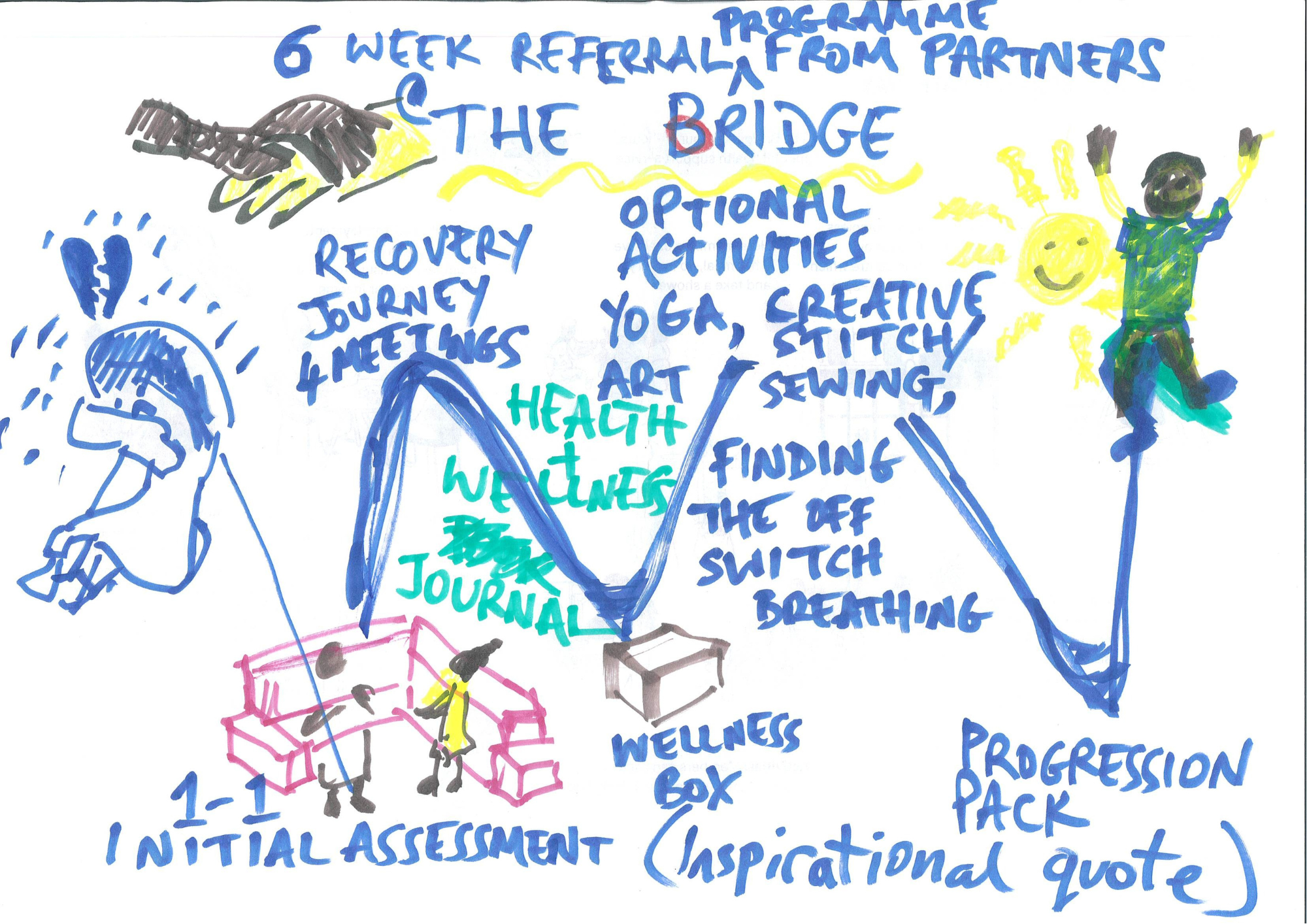
This information was collated and there was a back-and-forth with the graphic-designer turning the prototype design into the finished infographic (see below) which the group then signed off on.
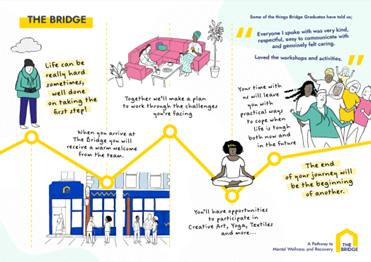
It can be a struggle trying to get into the head of people that access our services. What would they appreciate knowing before accessing the service? What would help them understand it? How was their experience of the service? What was important to them?
Staff can go back and forth with ideas for weeks trying to get it right. Then common-sense kicks in and you realise we don’t need to try and get in their heads, we can just involve them in the process, and they can input directly into the project themselves. No filtering, no assuming, straight from the people who matter most, those who have lived experience.
It gives the staff team confidence as well, knowing that the finished product has been co-designed and endorsed by the people they have been working with and ultimately who they are there to support.
A quote via email from somebody involved:
“Thank you for your lovely, enthusiastic email. It was a pleasure to be part of the focus group in July co-producing the infographic with other clients.
I am especially flattered and proud that you have chosen to use my drawing as a starting point for the finished result, which looks great. I am pleased that you kept my original humour and multi-cultural positivity, down to details like my initial meeting with [Name] on the big pink sofas!
It is good to be able to give something back to a really helpful resource, delivered by a great, friendly team who each provide valuable advice and support to equip clients with a toolkit to get back on track to cope better with life’s challenges.”
“I just feel so much more confident, the organisation as a whole, knowing that we've got that lived experience voice in the room as part of the employed team.”
Context and Aims
In April 2023, Forest Churches Emergency Night Shelter secured funding from NHS Social Prescribing to enhance co-production through training for staff and volunteers. This initiative involved collaboration with four other Day Centres, supported by Expert Link and Trust for London.
A FCENS lived experience group was formed and met monthly. The group agreed three core aims.
- To empower people with lived experience of homelessness, through access to training, social events and co-production activities at FCENS.
- To inform best practice at FCENS and to co-design development of our service.
- To influence key stakeholders and decision-making bodies in Waltham Forest, to improve lives for people with experience of homelessness in our Borough.

Peer Coaches
After the initial development of the Lived Experience Group, it was agreed to advertise for a part-time Peer Coach to join the team. The job description for this role was similar to the scheme developed by The 999 Club. This was advertised in December and interviews took place in February 2024. Two strong candidates were interviewed and both candidates were appointed on an initial four-month contract.
The purpose of the role is to provided peer support for guests at FCENS, and to lead on developing the lived experience group work.
Peer Coaches are heavily involved in co-designing and co-producing their own programme of work. Each of them is mentored by a Caseworker, and they co-work with guests to partner for peer support. This has been effective in providing rounded support to people while they stay at the shelter.
Caseworkers provide specialised support for housing and advocacy. Peer Coaches provide support to encourage guests with activity focussed on well-being. This partnership develops a positive culture that helps guests feel involved and respected in their journey.
Peer Coaches are also involved in fundraising for ongoing activities for the lived experience group and have organised a sponsored walk for guests through Walthamstow Marshes. A variety of activities have been led by Peer Coaches.
All guests staying at FCENS since March have benefitted from contact with Peer Coaches. Lived experience sessions are open to clients within other organisations too and clients from other charities have taken part in this.
Observations so far
- Peer Coaches have a positive impact on the team serving at FCENS
- Their lived experience directly influences trauma-informed approaches to our work
- Peer Coaches help to build positive and deep relationships with beneficiaries / guests.
- Employing Peer Coaches create clear boundaries between staff and guests.
- As an employer, it has been positive to pay lived experience staff for their work in leading the lived experience group.
- The Lived Experience Group has been difficult to sustain a consistent membership. Supermarket vouchers have been very helpful and appreciated by participants taking part. This has helped to value people and their time. Some have contributed well to sessions. There is a risk that guests attend just to receive the voucher.
Boundaries & Well-being for Peer Coaches & Lived Experience Group
Co-production work with people with lived experience of homelessness necessarily means engaging with and valuing people who have experienced trauma and often have continuing complex and varied needs. This process is messy and there is no one size fits all. We have valued employing people with lived experience. Other services on the Day Centres group prefer volunteer programmes.
It has been important to be flexible in our approach to employment. Working hours need enough flexibility to accommodate bad days and changes of circumstances. We check in regularly with our Peer Coaches to review working conditions to ensure that their needs are met consistently.
“This process is messy and there is no one size fits all.”
The work of the Peer Coaches requires them to develop relationships with guests to provide well-being support. Maintaining appropriate boundaries in these relationships is challenging and requires training. Mentoring support from Caseworkers in this area has helped. It has been important for Peer Coaches to have working hours, work emails and a work phone, to ensure personal contacts and personal time is protected.
We have learned to avoid facilitating personal contact between members of the lived experience group. The group initially set up a WhatsApp group to share ideas and for planning; in hindsight this was a bad idea as it allowed the group to see and share contact details of other members. This had a negative impact on at least one member who has since left the group.
Progress towards aims
We are making very good and measurable progress towards aims 1 and 2 (to empower people; to inform best practice and co-design services). Progress towards aim 3 (to influence key stakeholders) is slow and depends on further collaboration with external bodies. We are open to engagement with local groups who are ready to engage with lived experience voice.
Next Steps
Contracts have been extended to March 2025 for both Peer Coaches. Roles will be reviewed at that time.
The Women’s Sanctuary at the 999 Club is a safe and welcoming space exclusively for women. We provide a safe, supportive environment, both physically and emotionally.
We’re building a community where women can socialise, share knowledge, compassion and support. We offer workshops, events and activities. The Sanctuary is part of a wider network of support where women can access advice, links and referrals to further focused support and services (e.g. Athena/Refuge).
Many projects decide to set-up a service or project and then bring in the service-users at that stage to co-design it. Consultation, co-design and service-user involvement all have a distinct beginning and end to the process. Co-production is a continual process always in motion: a cycle of ideas, co-design, delivery, evaluation, adaptation and then fresh ideas.
The Women’s Sanctuary is an example of including service-users at every stage, including inception. The idea itself to create a safe space for women came from speaking to the women who were currently using our service, as well as those who were not. The feedback we received was that women didn’t feel comfortable in a male-dominated space. They expressed a need for a safe space exclusively for women.
We began co-designing and planning the space, involving as many women with lived experience in the process as we could. It was a collaborative effort, the women deciding on everything; from the name of the space, to the colour we painted the walls, to the type of furniture and decorations within, to the services, groups, activities and workshops we would provide. We even had some of our members (service-users) help us paint the space during the decoration phase. This active participation created a sense of ownership of, and investment in the space.
We also enlisted women with lived experience to help deliver the services within the Sanctuary. The space and services within continue to grow and develop through the community of women that use the Sanctuary, going beyond co-production at times into ‘user-led’ territory.

One of our members (service-user) who had been involved in the development of the Sanctuary became a volunteer delivering workshops and discussions in the space. These proved so successful we hired her as a sessional worker (self-employed) to expand upon these activities. They had been out of work for some years and were anxious about the prospect of returning to work so this middle ground helped them to develop confidence at a gradual pace. Her confidence grew even more and she applied for the role of Peer Coach in our Move+ service where she has now been employed for over a year.
A challenge was letting go of the initial vision we had in mind for the future, resisting the temptation to steer the development of the Sanctuary in a set direction. We really wanted the women who used the space to lead where it went after it was set up. It can be difficult to let go of those visions and trust in the process that the project will develop organically in the direction it needs to go.
When you see the success of letting go of that power however, it’s extremely motivating.
You see the power of co-production in action.
When allowed to breathe in this manner a project almost becomes a living entity, growing on its own.
The Passage have set up a Lived Experience Assembly which is a new group sitting alongside senior management:
-
- Newly established group to represent lived experience alongside senior management teams
- Focus on ensuring that the voices of those with lived experience influence strategic decisions within the organisation
- Regular meetings facilitate collaboration and consultation between lived experience representatives and senior management, enhancing trust and transparency
- Consulting on major strategic decisions
- Consulting with lived experience groups can enhance the relevance and effectiveness of strategic decisions by incorporating diverse perspectives.
- Engaging with these groups fosters trust and transparency within the organisation, ensuring that decisions reflect the needs and experiences of those directly impacted.
- Regular consultations can lead to innovative solutions and community-driven initiatives that align with the organisation's mission and goals.
- Starting small with proof of concept approach
- Starting small allows for manageable implementation and reduces risk of failure.
- A proof of concept helps to validate ideas before scaling, ensuring they meet the needs of stakeholders.
- Repeatedly gaining feedback from initial trials can guide adjustments and improvements for future phases.

- Meeting frequency increased due to success
- Meeting frequency increased from quarterly to every three weeks due to positive outcomes.
- Increased engagement from senior management in consulting with the lived experience group.
- Demonstrated proof of concept led to greater trust and momentum for ongoing collaboration.
- As this governance project has been such a success in its current form, The Passage are looking to expand its reach/grow at the end of the pilot.
